You regularly ask clients or patients how likely they are to recommend your practice. You collect the responses, calculate your Net Promoter Score, and get a number. But what does it actually mean? Is an NPS of 35 good for a law firm? Should a healthcare practice aim for 50, 60 or higher?
The challenge is that no single benchmark applies to every industry. Published NPS benchmarks vary by research provider, survey method, audience, and year. A score that looks average in one report may appear strong in another.
This guide explains what a good net promoter score is, what available benchmarks suggest for healthcare and professional services, and why tracking your own NPS trend can be more useful than chasing a single industry average.
What Is a Good Net Promoter Score?
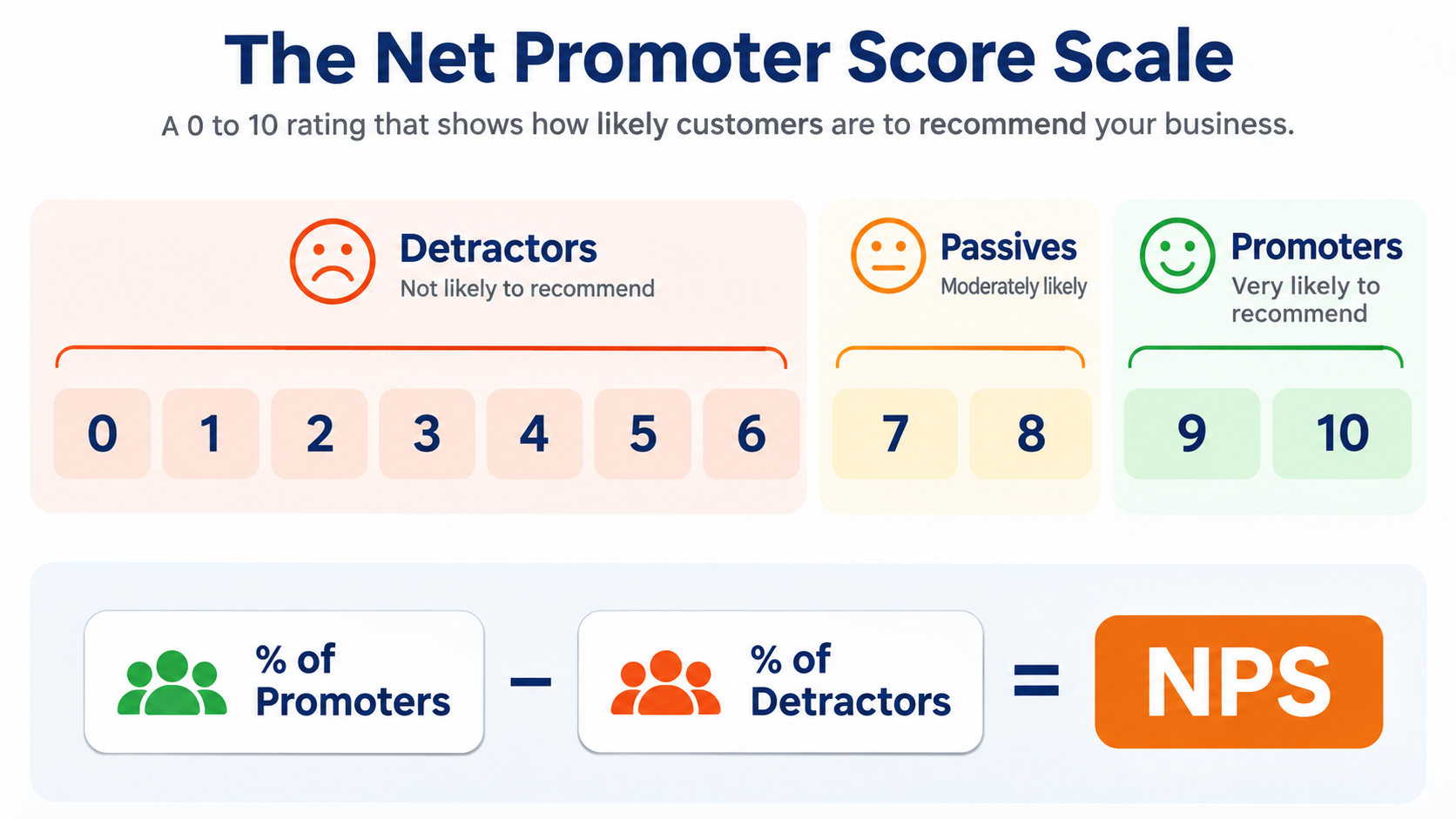
A Net Promoter Score, or NPS, measures how likely customers are to recommend a business, service, or professional practice to someone else. Respondents answer a question on a scale from 0 to 10.
Their answers are grouped into three categories. Promoters give a score of 9 or 10. Passives give a score of 7 or 8. Detractors give a score between 0 and 6.
NPS is calculated by subtracting the percentage of detractors from the percentage of promoters. Passives are included in the total number of responses but are not included directly in the subtraction.
For example, if 60% of respondents are Promoters and 20% are Detractors, your NPS is 40.
The score ranges from minus 100 to plus 100. A positive score means you have more Promoters than Detractors. However, a positive score alone does not tell you whether your practice is performing well compared with similar organizations.
SurveyMonkey describes scores from 0 to 30 as good, 30 to 70 as great, and 70 to 100 as excellent in its general interpretation. Perspective AI uses a different set of broad thresholds, describing scores above 20 as favorable and above 50 as excellent. These are useful guidelines, not universal industry rules.
NPS Benchmarks by Industry: Why the Numbers Disagree
Search for NPS benchmarks by industry, and you may find several different answers. One report may suggest that a good professional services score is around 30 to 50. Another may place the average closer to 60. Healthcare benchmarks can vary just as widely.
For example, Perspective AI's 2026 benchmark guide places healthcare at an approximate average NPS of 38 and consulting or professional services at around 60. SurveyMonkey's benchmark data gives healthcare a median of 62, with a lower quartile of 37 and an upper quartile of 82. Its 2024 healthcare benchmark was 38.
These figures are not necessarily contradictory. They come from different datasets and may use different respondent groups, sampling methods, survey periods, and definitions of an industry. A broad healthcare category can include hospitals, specialist clinics, medical services, and other providers with very different patient experiences.
The same issue applies to professional services. A benchmark for consulting firms may not accurately represent a small law practice, an accountancy firm, or a specialist advisory business.
The practical lesson is simple: use industry benchmarks as a reference point, not as a definitive verdict on your practice.
What Is a Good NPS for Healthcare?

Healthcare NPS benchmarks are particularly varied because patient experience depends on many factors beyond the clinical outcome. Appointment availability, waiting times, communication, staff behavior, billing, and the overall care experience can all influence whether a patient recommends a provider.
Perspective AI reports an approximate healthcare average of 38 in its 2026 industry guide. SurveyMonkey's benchmark data reports a healthcare median of 62, with a lower quartile of 37 and an upper quartile of 82. Its 2024 healthcare benchmark is also listed as 38.
A separate 2024 professional services benchmark report from Service Performance Insight recorded a healthcare segment NPS of 63.3. This is another example of why the source and the population being measured matter.
So, what is a good NPS for healthcare? A score around 40 may be a positive result in one dataset, while a score above 60 may be closer to the median in another. Rather than treating either number as a universal target, compare your practice with the most relevant patient experience benchmark you can find and monitor whether your own score improves.
What Is a Good NPS Score for Law Firms?

Law firms face a different client experience challenge. Clients may be dealing with stressful personal or business situations, complex legal processes, uncertain timelines, and significant financial decisions. Clear communication, responsiveness, transparency, and confidence in the advice they receive can strongly influence their willingness to recommend a firm.
There is no single widely accepted, current NPS benchmark that represents every law firm. SurveyMonkey publishes a consulting benchmark with a lower quartile of 42, a median of 48, and an upper quartile of 72. This can offer a broad professional services comparison, but it should not be presented as a direct law firm benchmark.
A more specific example comes from Insight6's 2025 Professional Services Client Journey Report. It measured the experience of prospective clients at the inquiry stage and reported an NPS of minus 41 for legal firms. This is not an overall client relationship score. It measures a particular early interaction, which is why it should not be compared directly with a firm's post-matter client NPS.
For a law firm, the most useful approach is to measure feedback at consistent points in the client journey. You might ask for feedback after an initial consultation, after a major case milestone, or when a matter is completed. Keep these results separate so you can understand which part of the experience needs attention.
Why Tracking Your NPS Trend Matters More Than One Score
An industry benchmark gives you context, but your own trend tells you whether your client or patient experience is improving.
Imagine your practice records an NPS of 24 in January, 31 in April, and 39 in July. Even if another industry report suggests that the average is higher, your results show a positive direction.
For a meaningful comparison, use the same NPS question, the same rating scale, and a consistent survey method each time. Record when the survey was sent, how many people responded, and which part of the experience they were rating.
It is also useful to separate feedback by service type, location, or client journey stage where your response volume allows. A healthcare practice may discover that appointment scheduling receives lower ratings than the clinical consultation. A law firm may find that clients appreciate the legal advice but want more frequent case updates.
Always review the comments behind the scores. NPS tells you how many Promoters you have relative to Detractors. The written feedback helps explain why.
How to Collect NPS Feedback With CliqForms
You do not need a complicated feedback process to start measuring NPS. You need a clear question, an easy way for people to respond, and a consistent method for reviewing the results.
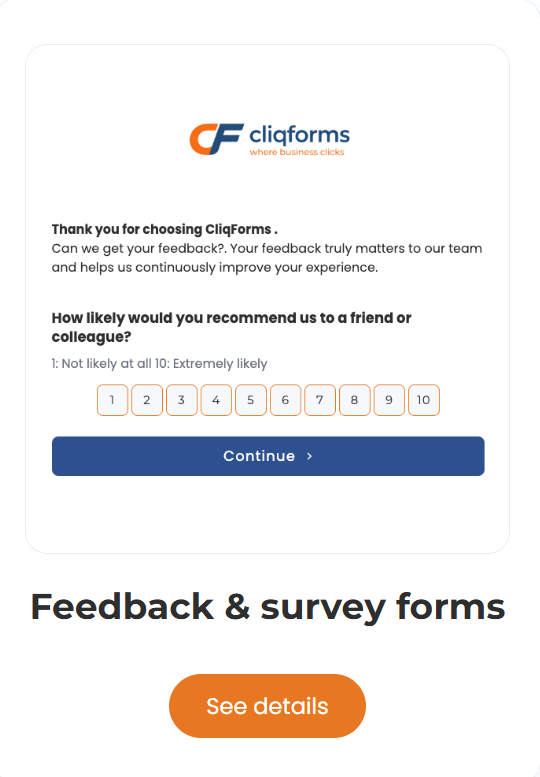
With CliqForms, you can create a customized NPS survey using a rating question and follow-up questions that capture the reason behind the score.
For example, your survey can ask:
"On a scale of 0 to 10, how likely are you to recommend our practice to a friend, family member, or colleague?"
You can then use conditional logic to create different endings for different respondent groups. A Promoter who selects 9 or 10 can see a thank you message and an optional question asking what they valued most about the experience. A Detractor who selects a score from 0 to 6 can see a message thanking them for their honesty and inviting them to explain what could have been better.
Passives can receive a separate follow-up asking what would make their experience better.
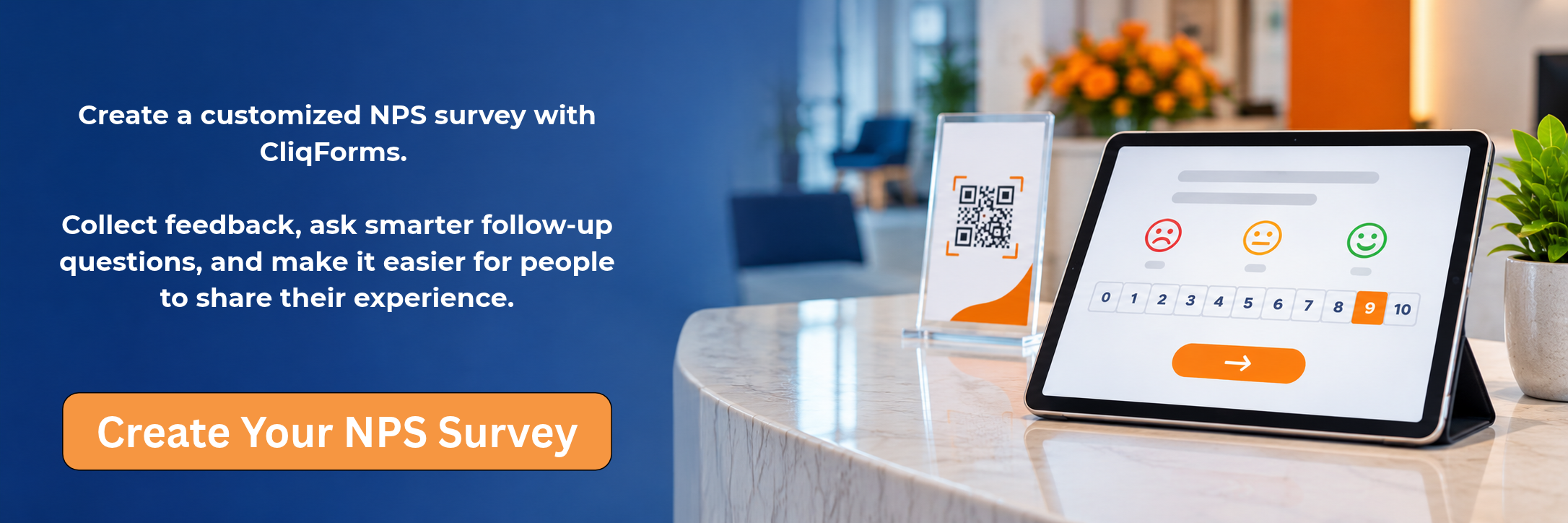
For a healthcare practice or professional office, you can also create a QR code that links directly to the NPS form. Display it at reception or include it on an appropriate feedback card so clients and patients can respond using their phones.
Remember that CliqForms helps you create and collect NPS survey responses. It does not automatically calculate your Net Promoter Score. Once you have collected the responses, use a free NPS calculator, such as the SurveyMonkey NPS Calculator, to calculate your score.
This gives you a practical workflow: create the survey in CliqForms, collect responses through a link or QR code, calculate the score separately, and review the feedback to identify improvements.
For healthcare providers, make sure your survey does not request unnecessary sensitive patient information. Follow your applicable privacy and data protection requirements when collecting and storing feedback.

Frequently Asked Questions
What is considered a good Net Promoter Score?
A score above zero means you have more Promoters than Detractors. Some general guidelines describe 0 to 30 as good, 30 to 70 as great, and above 70 as excellent. However, the right interpretation depends on your industry and survey methodology.
What is a good NPS for healthcare?
Published healthcare benchmarks differ. Perspective AI reports an approximate average of 38 in its 2026 guide, while SurveyMonkey reports a median of 62 in its benchmark dataset. Compare your practice with a relevant source and track your own results consistently.
What is a good NPS score for law firms?
There is no single current benchmark that applies to all law firms. Consulting benchmarks can provide a broad professional services reference, but legal inquiry experience and overall client satisfaction should be measured separately.
How often should a business measure NPS?
Many practices can start with quarterly surveys and add feedback requests after important client or patient interactions. The best frequency depends on how often people use your services and whether you can collect enough responses to identify meaningful patterns.
Does CliqForms calculate NPS automatically?
No. CliqForms helps you create and distribute NPS surveys and collect responses. You can use a separate free NPS calculator to calculate the score from your Promoter and Detractor percentages.
Can I collect NPS feedback using a QR code?
Yes. You can create a QR code that directs clients or patients to your CliqForms NPS survey. Place it at reception or on an appropriate feedback card to make it easy for people to respond using their phones.
Final Thoughts
So, what is a good net promoter score? The honest answer is that it depends on your industry, the people you survey, and how you collect their feedback.
Healthcare benchmarks can range from the high 30s to the 60s in the reports discussed here. Professional services figures vary too, and a prospective client's experience with a law firm's enquiry team is not the same as the experience of an established client.
Do not let one benchmark define your practice. Choose a relevant comparison, measure consistently, look for changes over time, and use written feedback to understand what needs attention.
With CliqForms, you can build a simple NPS survey, guide Promoters and Detractors to relevant follow-up questions, and make it easier for clients or patients to share their experience through a QR code. Pair the collected responses with a free NPS calculator, and you have a straightforward starting point for improving the experience your practice delivers.